
Tuesday at 8:12 a property manager sent me a photo of a fingerprint on the second-floor boardroom glass. The nightly had run. The glass was never on it.
That is the hour people search what does commercial cleaning include. They want the invoice to match the rooms they walked at 8 a.m.
Commercial cleaning is the recurring work after lockup: floors, washrooms, kitchens, bins, and the touch points a crew can reach without a ladder or a locked door. Exterior glass, carpet extraction and strip and wax are different jobs. If you fold them into “nightly” without writing them down, someone skips them, or someone does them once and you argue about the bill.
The short version
| Usually in the nightly | Booked as a periodic | Usually not included |
|---|---|---|
| Vacuuming and mopping walked floors | High dusting above standard reach | Inside desks, drawers and filing cabinets |
| Bins | Interior glass that needs a ladder or pole | Server closets, alarm panels, locked comms rooms |
| Washrooms | Carpet extraction | Plants, fish tanks, anything a vendor services |
| Used kitchen surfaces | Full VCT strip and wax | Construction dust after trades |
| Lobby mats, elevator plates, the stairs people take | Move-out of a vacant suite | Medical waste and sharps |
What commercial cleaning looks like by building
Commercial cleaning here means janitorial work on a commercial floor, on a schedule you can name. What that means depends on the building:
- Office: desks and a kitchen.
- Warehouse: aisles, the floor under the first racking bays, and the washroom by the time clock.
- Restaurant: the dining room plus the grease you can reach after close. A hood clean is a separate booking.
Named rooms get done. Mystery extras get a quote.
What the nightly actually covers
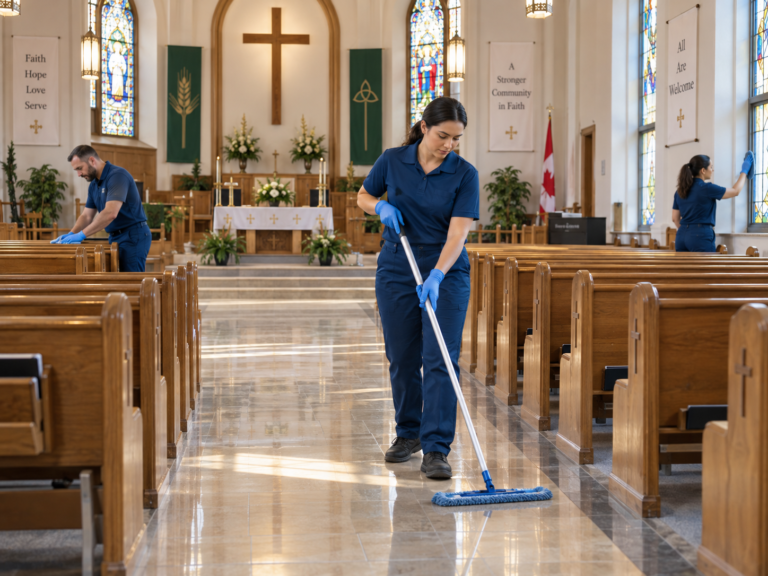
A nightly commercial clean is a route. The crew vacuums and mops the floors people walk, empties bins, and wipes the open surface of desks and the chair wells. In kitchens that means the parts people use: counters, sink rim, microwave plate and fridge handle. In washrooms it means bowls, seats, counters, taps, mirrors and floors, plus restocking if you leave product in a cupboard we can open. It also covers lobby mats, elevator call plates and the stairs people actually take. In winter, the entrance mats and lobby floor are where the salt line starts, so say how often you want that area done.
That’s the include. It’s boring on purpose. Boring is what 6 a.m. looks like when the route was written.
Occupied desks stay occupied
If the light is on and a coat is on the chair, we work the aisle and leave that bay. Paper stays in the pile. Drawers stay shut. I won’t “neaten” a stack. Last winter a USB stick with payroll files sat under a printout. I moved the printout. I spent the next morning on a call with IT I didn’t want.
Kitchens are where nights go sideways
Coffee grounds around the machine, a sticky counter, the compost if we’re allowed to dump it. We don’t defrost a freezer unless that’s on the ticket. I once pulled a tray of unlabelled soup because it smelled. The floor lead had been saving it for a Friday potluck. That’s on me, and it’s why leftover rules go on the booking now.
Periodic work people bury in “included”
Some work doesn’t belong in the nightly:
- High dusting above standard reach
- Interior glass that needs a ladder or a water-fed pole
- Carpet extraction
- A full VCT strip and wax
- Post-construction dust after trades
- A move-out of a vacant suite
Mix these into every nightly and the nightly balloons, or they never happen and you get the 8:12 photo.
Say which nights get the extra. “First Friday high dust on floors 2 and 3” is something a crew can run. “Keep it looking professional” isn’t. I’ve quoted both, and only one survives a night note.
For floors, our guide to carpet cleaning vs floor waxing explains how to book extraction and strip and wax so they don’t get lumped in.
If you already have a window vendor on a quarterly, tell us. We’ll wipe entry glass at hand height and leave the rest, so you aren’t billed twice for the same pane.
What we won’t do on the nightly
- Inside desks, drawers and filing cabinets
- Plants, fish tanks and anything a vendor already services
- Server closets, alarm panels and locked comms rooms
- Personal cups and dishes left on a desk (we wipe around them)
- Exterior glass above the first ladder height we agreed in writing
- Construction dust, paint overspray or a punch list after trades, which is a different booking
- Medical waste, sharps, or anything a clinic has a licensed pickup for
I also won’t invent a default for leftovers. A labelled container with a name on it stays. Empty boxes in the bin area go. An unlabelled tub at 9:40 p.m. is a judgement call I refuse to make. Write “Friday pull” or “leave it” on the booking and I’ll follow that.
Whiteboards with a date still on them stay. Conference-room click-share dongles stay in the table well, and we wipe around them. I once coiled a dongle into a drawer “to neaten” and took a 7 a.m. call about a black screen. Once was enough.
The glass question
Common-area glass at entry height is usually on us. Tenant glass inside a locked suite usually isn’t, unless the suite is on the ticket. Boardroom glass on a floor we already mop is where the arguments start. Some managers want every pane wiped nightly because tenants see it. Some building operators say interior glass is a quarterly and the nightly is floors and washrooms. I’ve sat in a meeting where both people thought the other had already decided.
I don’t have a default for this one. When a spec leaves it open, I quote it both ways and ask before the first night. The fingerprint from Tuesday was on exactly that pane. We had mopped. We hadn’t climbed. The spec said “glass” with no height and no room name, and the word did no work.
If you want interior glass on the nightly, name the rooms and the height. If you want it monthly, name the month. I’d rather hold a night than wipe a film the window vendor has scheduled for Thursday, then take a complaint that we used the wrong product on Low-E.
How to write the scope so the night matches
Send a floor plan, or a phone walk that names the rooms. Include:
- Typical lockup time, not just “we close at 5”
- Which desks stay occupied
- Leftover rules for the kitchen
- Where washroom product is kept
- Lobby glass vs tenant glass, and the height
- The elevator count
- Which stair people use
- Any gym, yoga room, locker hall or mother’s room, by name
- Photos of the worst washroom, the kitchen at 6 p.m., the lobby mat and the boardroom glass that started this post
We’ll tell you whether it’s one nightly or a nightly plus a weekly for amenities.
Frequently asked questions
What does commercial cleaning include?
The recurring after-hours work: floors, washrooms, kitchens, bins and the touch points a crew can reach without a ladder or a locked door. The rooms should be named in writing.
Is window cleaning included in a commercial cleaning contract?
Usually only glass at hand height in common areas. Interior glass that needs a ladder or pole, and exterior glass, are booked separately unless the ticket names the rooms and height.
Is carpet cleaning part of the nightly?
No. Vacuuming is. Carpet extraction is a separate booking.
Are strip and wax or deep cleans included?
No. A full VCT strip and wax, post-construction cleaning and suite move-outs are periodics. Say which nights get them.
Is janitorial the same as commercial cleaning?
For most buildings, close enough. The label matters less than having the rooms and the schedule written down.
Get the include written down
Send the room list, the photos and the leftover rules, and we’ll walk the rooms or the photos before we lock a spec. Book a free consultation