When people talk about indoor air quality, the conversation usually jumps straight to HVAC. Ventilation, filters and outdoor-air supply do matter. But they are only half the story.
Dust settles on floors and ledges. Shoes carry grit through the front door. Carpet traps fine particles, and cleaning products add their own compounds to the air. A slow leak near an entrance can sit unnoticed for weeks.
That is why commercial cleaning and indoor air quality are closely linked. A good cleaning program will not replace ventilation or HVAC maintenance. It can, however, control a lot of the dust, debris and moisture that building managers deal with every day.
This guide covers where cleaning fits into an indoor air quality (IAQ) plan, where it stops, and what to write into your cleaning scope.
If you are reviewing a recurring workplace program, Everest’s office cleaning service covers scheduled floor care, dusting, washrooms, kitchenettes and other routine work around building occupancy.
Commercial cleaning and indoor air quality: how are they connected?
IAQ depends on several things working together: the building envelope, outdoor air, HVAC equipment, furnishings, moisture, occupancy and daily activity. Housekeeping is one of those daily activities, and it can help or hurt.
Foot traffic and dry dusting stir up dust left on floors, carpet and ledges. Moisture that nobody notices turns into bigger building problems. Cleaning chemicals can add odours and volatile compounds when crews choose them poorly or use them the wrong way.
Health Canada’s 2025 guidance on indoor air quality in office buildings lists housekeeping among the operating practices that support better air. It points to preventing dust build-up, using damp or wet cleaning where appropriate, choosing lower-emission products and using HEPA-filter vacuums where possible.
Facility managers building a broader IAQ program can read the full Health Canada guidance on improving indoor air quality in office buildings.
1. Dust control and indoor air quality depend on the cleaning method
A desk can look clean while fine dust sits in corners, carpet fibres and the ledges crews skip during a fast nightly pass. The method decides whether you remove that dust or simply move it.
Dry sweeping and hard dry dusting lift settled particles back into the room. Damp wiping and microfiber systems capture them instead.
A practical scope names the surfaces that get routine dusting:
- Desks and other accessible horizontal surfaces
- Window ledges and partition tops
- Baseboards
- Reception counters
- Meeting-room furniture
- Hard floors and carpeted traffic lanes
Dust also collects above eye level, on high ledges, door frames, accessible grilles, light fixtures that are safe to reach, and exposed pipes or beams. These jobs do not belong on every nightly visit. They work better as scheduled periodic tasks written into the cleaning plan.
Frequency should match the building. An office beside a busy road, a lobby with constant visitors and a quiet professional suite will not need the same schedule.
2. Why HEPA-filter vacuuming matters for indoor air quality
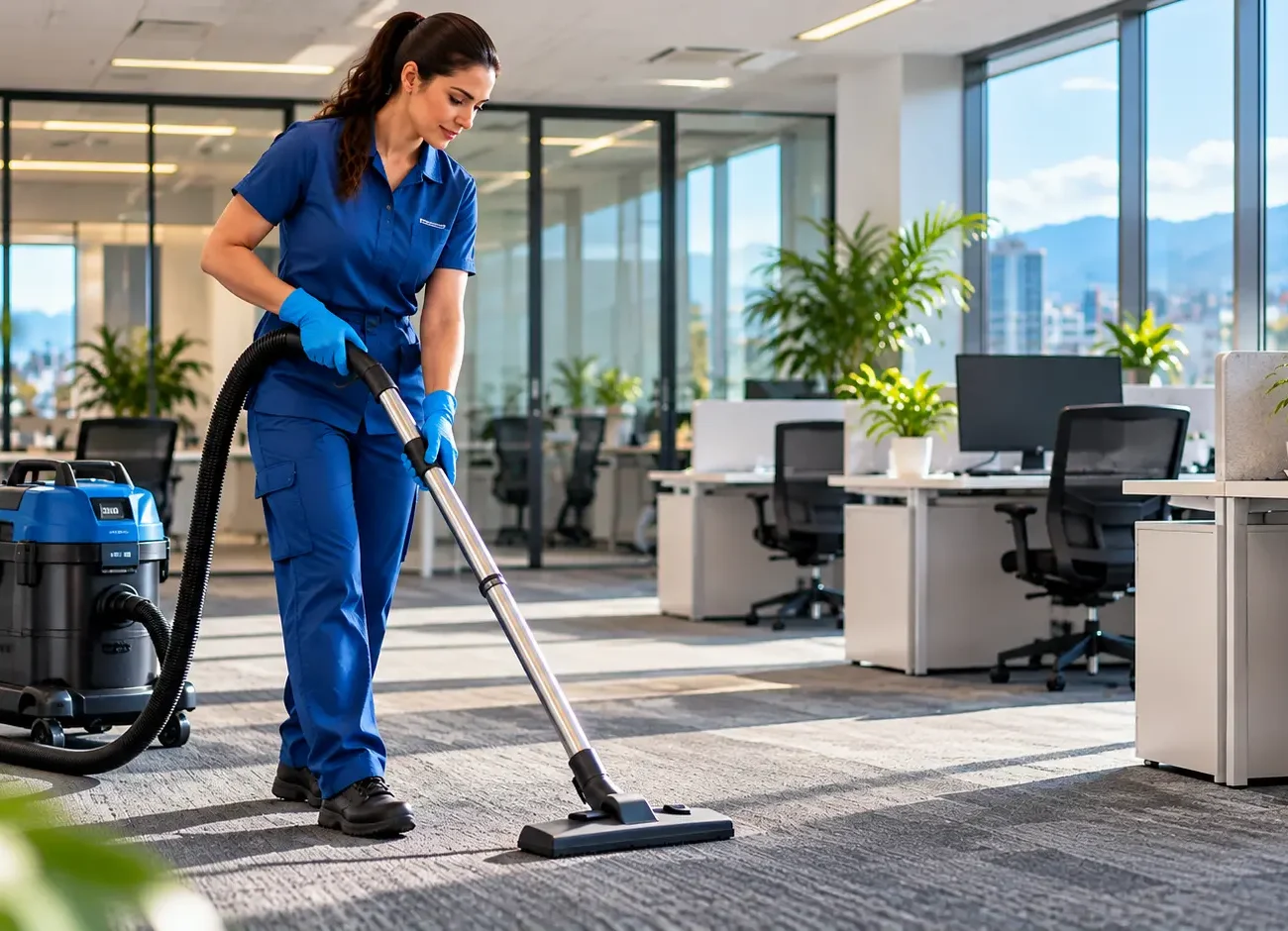
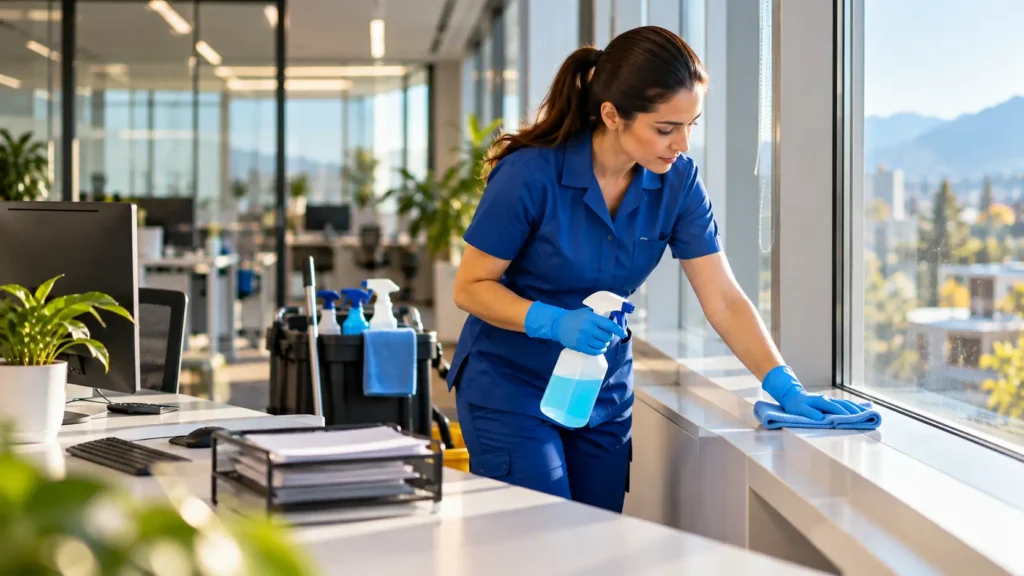
Vacuuming is one of the most important recurring tasks in carpeted buildings, and it ties commercial cleaning and indoor air quality together directly. The equipment matters as much as the schedule.
Health Canada recommends vacuums with high-efficiency particulate air (HEPA) filtration where possible. The idea is simple. Collect fine particles without letting much of them escape back into the occupied space.
It pays off most in carpeted offices, meeting rooms, reception areas, corridors, elevator landings and entrance zones.
You also have to look after the machine. A good filter does little if the bag is overfull or the filter is overdue for replacement. Because contractors do not all use the same equipment, we suggest putting your vacuum requirements in the written scope instead of assuming.
3. Carpet care and indoor air quality: carpet holds more than visible dirt
Commercial carpet takes thousands of steps, especially at entrances, in corridors and in shared spaces. Dust and grit work down into the pile, where surface vacuuming eventually stops being enough.
Most carpet programs run on two levels.
Routine vacuuming
This is the recurring task. It removes loose soil before it becomes embedded.
Periodic carpet extraction
Extraction is the deeper clean for traffic lanes, entrances and other high-use areas.
Timing matters here. Carpet needs time to dry before heavy occupancy returns, which is why crews often book extraction after the building closes.
Everest’s commercial carpet cleaning service covers offices, corridors and other commercial carpet areas, including close-of-day work where drying time has to fit between shifts.
4. Cleaning products are part of the indoor environment
A stronger smell does not mean a cleaner building.
Heavily fragranced products, unnecessary aerosols and unsuitable chemicals can all affect the air in an occupied space. Health Canada recommends considering lower-emission products and following the manufacturer’s instructions.
Four questions are worth asking your cleaning provider:
- Which products does the crew use for routine cleaning?
- Do crews dilute them exactly as the label says?
- Does this task really need a spray?
- Can the crew schedule strong-smelling jobs away from occupied hours?
You should also be able to get Safety Data Sheets on request. The goal is not to call products good or bad. It is to pick the right one for the job and use it correctly.
5. Entrances are part of the dust-control plan
Not all dirt starts indoors. A lot of it walks in the front door.
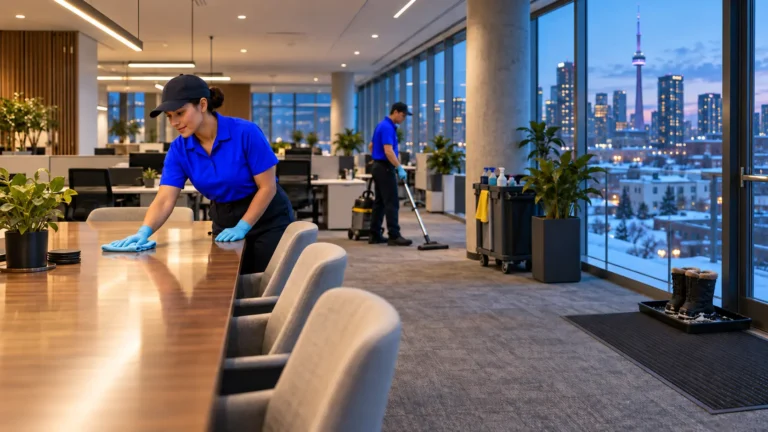
Shoes bring in soil, road dust, pollen, moisture and, through a Canadian winter, salt and slush. Once that material gets past the entrance, foot traffic spreads it through the building.
A well-kept entrance helps commercial cleaning and indoor air quality at the same time, because the crew has less to chase down corridors later. The cleaning plan should cover:
- Entrance mats and vestibules
- Floor edges around the mats
- Water and snow from exterior doors
- Vacuuming or extraction of saturated mats
- Extra floor attention in bad weather
Health Canada’s office guidance recommends keeping entryways clear of water and snow, and keeping mats clean and dry so less moisture and debris enters the building.
6. Moisture problems should be reported, not ignored
Cleaners are often the first people in a building after staff go home, so they are well placed to spot trouble that would otherwise sit overnight. Examples include:
- Water pooling near an entrance
- A recurring leak under a sink
- Damp carpet
- Ceiling stains
- Constant condensation
- A musty smell that keeps coming back
Health Canada’s guidance also suggests inspecting buildings after heavy rain or rapid snowmelt, which fits what cleaning crews see on the floor.
Spotting a problem is different from fixing it. Do not expect a cleaning contractor to diagnose or remediate a moisture or mould issue. Larger or repeated problems belong with building maintenance, an occupational hygienist, an HVAC professional or another qualified specialist.
What your scope needs is a clear process. Who reports the issue, who receives the report, and what happens next?
7. Cleaning and HVAC maintenance are different jobs
In any commercial cleaning and indoor air quality plan, this distinction is worth keeping straight.
Commercial cleaning looks after the occupied space: floors, carpet, furnishings, washrooms, kitchens, entrances and accessible surfaces. HVAC maintenance looks after the systems that move, condition and filter air.
A clean floor cannot make up for a poorly performing ventilation system. In the same way, a new HVAC filter will not remove dust sitting on desks, carpet and ledges.
Health Canada recommends preventive ventilation maintenance, appropriate filtration, and checking that ventilation still suits how the building is used. If you suspect a ventilation fault, get air-quality complaints you cannot explain, or worry about contamination inside the mechanical system, call a qualified HVAC or IAQ professional. Do not treat it as a janitorial task.
8. What should a commercial cleaning and indoor air quality scope include?
If IAQ is on your priority list, “keep the office clean” is not enough of an instruction. Write the important requirements down. A useful scope can specify:
- Which areas the crew vacuums, and how often
- Whether the crew must use HEPA-filter vacuums
- Which surfaces get routine damp dusting
- How often high dusting happens
- How the crew cleans and maintains entrance mats
- When carpet extraction happens
- Which cleaning products you approve
- How crews dilute and store chemicals
- Who reports leaks, damp carpet or unusual moisture, and who receives those reports
- How cleaning fits around occupied hours
That last point deserves a note. After-hours cleaning keeps vacuums away from meetings, lets mopped floors dry with less foot traffic, and gives crews access to desks and shared spaces that are busy during the day. It is not right for every building, though. Clinics, warehouses and multi-shift sites often need cleaning split into several passes.
For offices, a recurring cleaning schedule can separate nightly tasks, weekly floor work and periodic detail cleaning, so everything is not squeezed into one visit.
Put the scope in writing and you can measure the program. Leave it unwritten and the program depends on assumptions.
Commercial cleaning and indoor air quality: one part of a broader plan
No single product, machine or procedure delivers good indoor air. Ventilation, filtration, moisture control, building maintenance, occupancy and housekeeping each play a different role.
Cleaning contributes by controlling settled dust and debris, maintaining floors and carpet, managing entrance dirt, using suitable methods and flagging conditions that need maintenance attention. Cleaning teams look after the occupied environment. HVAC engineers, building operators and IAQ specialists handle anything that needs a mechanical-system assessment or a specialized investigation.
When those lines are clear, the building is easier to manage.
Frequently asked questions
Can commercial cleaning improve indoor air quality?
It can support an IAQ program by controlling settled dust, dirt, moisture and some contaminant sources. It does not replace ventilation, filtration or HVAC maintenance. Indoor air quality depends on several building systems and practices working together.
Should commercial vacuums have HEPA filters?
Health Canada recommends HEPA-filter vacuums where possible as part of housekeeping in office buildings. You still have to maintain the equipment and replace bags and filters when needed.
How often should an office be vacuumed?
There is no single right answer. Busy entrances and corridors need far more attention than private offices or lightly used meeting rooms. Base the schedule on occupancy, floor type, weather and how much soil enters the building.
Does carpet cause poor indoor air quality?
Not automatically. Carpet does collect dust and tracked-in material, though. Regular vacuuming and scheduled extraction keep that build-up under control.
Should cleaners handle mould?
Routine cleaners can and should report signs of moisture or suspected mould. Significant or recurring contamination needs trained personnel or a qualified remediation professional, and someone has to find and fix the source of the moisture.
Build the cleaning plan around your building
Commercial cleaning and indoor air quality both improve when the scope reflects how the facility is really used.
Everest provides commercial cleaning for offices and other business facilities across Vancouver and the Lower Mainland, Winnipeg, Kitchener, Ottawa, Toronto and Calgary. We build schedules around occupancy, floor types, entrances, carpeted areas and the recurring tasks your facility needs.
If you are reviewing your current scope, start with the areas where dust, traffic and moisture are hardest to control.
Book a free consultation and tell us how your facility operates. We will review your cleaning schedule, floor and carpet requirements, and the areas that need more consistent attention.