How often should an office be cleaned? For most Canadian offices the answer is a mix: some jobs every working day, some every week, and a few every couple of months. Washrooms, kitchens, garbage and the surfaces everyone touches need daily attention. Floors, dusting and deep work, on the other hand, run on slower cycles.
The right mix depends on how many people use the space, whether clients visit, what your floors are made of and what the weather is doing outside. However, you can start from a simple baseline and adjust it. If you would rather have someone walk the space with you, book a free consultation.
How often should an office be cleaned?
As a starting point, clean washrooms, kitchens, garbage and high-touch surfaces every working day. Then vacuum and mop floors somewhere between two and five times a week, depending on traffic. After that, do detail work such as vents and partition glass monthly, and put carpet extraction and high-level dusting on a periodic cycle, typically a few times a year or less.
Treat that as a starting point. For example, an older federal cleaning contract specification on CanadaBuys gives every task its own frequency, from vacuuming office areas twice a week to vacuuming office chairs four times a year. Your office will need a shorter list than that, but the idea still carries over: each task gets its own schedule.
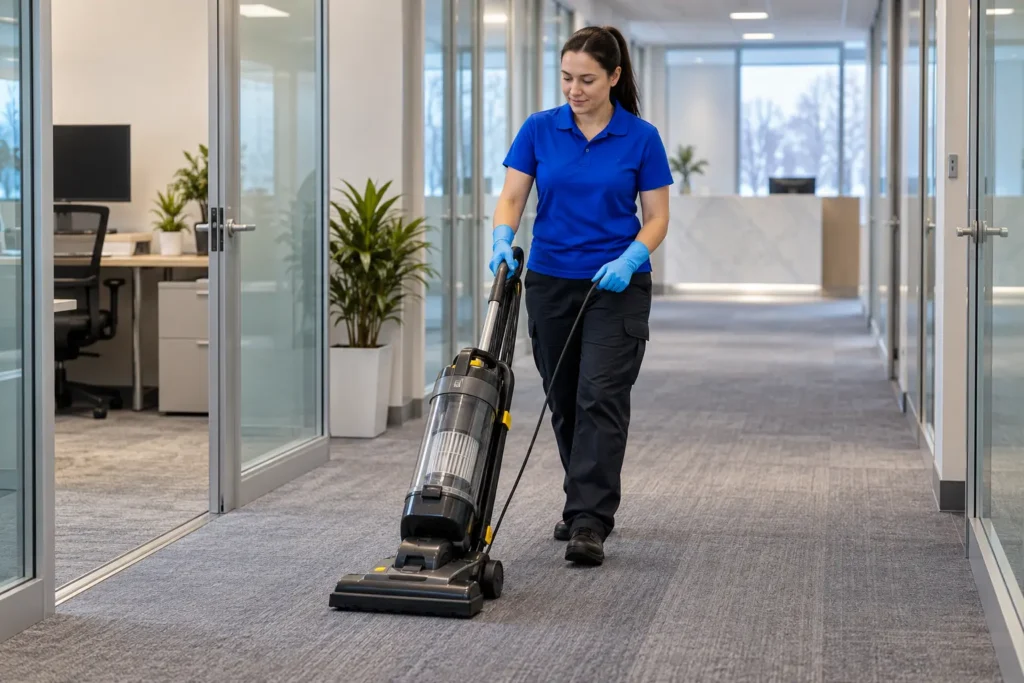
Office cleaning frequency by task
Most schedules settle into four layers.
Every working day
- Garbage and recycling emptied, liners replaced
- Washrooms cleaned and restocked
- Kitchen and breakroom counters, sinks and tables wiped
- Door handles, light switches, elevator buttons and other high-touch points disinfected
- Entrance glass and lobby floors cleaned
These are the areas where people notice a missed night first. That is why we would not move them to a thinner schedule when budgets get tight.
Two to five times a week
Vacuuming and mopping follow traffic. For example, a reception area and main corridors may need daily floor care, while a quiet row of private offices can often go two or three nights a week. Desks fit in this layer too, as long as staff clear their surfaces before the crew arrives.
Every week
- Dusting of ledges, shelves and furniture
- Detailed washroom work, such as partitions, grout lines and the undersides of fixtures
- Appliance exteriors and microwave interiors in the kitchen
- Spot cleaning of interior glass and partitions
Every month
Baseboards, vents and grilles, upholstery vacuuming and fridge clear-outs belong here. They do not need doing every week, but they build up quickly if nobody owns them.
Periodic and seasonal work
Carpet extraction, floor stripping and refinishing, high-level dusting and window cleaning follow longer cycles. How long depends on traffic and floor type, so ask the company to recommend an interval for each surface. Our guide to carpet cleaning vs floor waxing explains which floor job you need, and our carpet cleaning and high-level dusting pages show how those jobs run.
How often to clean an office, by office type
The same task list runs at different speeds in different offices. Three patterns come up most often.
A small office with a steady team
A team of about ten who are in most days needs washrooms, kitchen and garbage cleaned daily. Floors can then usually run two or three nights a week, while dusting and detail work happen weekly.
A hybrid office
If the office is busy from Tuesday to Thursday and nearly empty on Mondays and Fridays, a flat five-night schedule cleans empty rooms. Instead, move visits to the busy days, keep washrooms and the kitchen on a steady rhythm, and review attendance every quarter.
A visitor-facing office
Clients, couriers and walk-ins bring more dirt through the door and put reception under closer watch. As a result, plan daily care for the entrance and lobby, and give glass and floors closer attention. Also look at shift cleaning if washrooms and reception need a midday touch-up.
So how often should an office be cleaned? It depends on which of these patterns yours resembles, and a walkthrough settles it quickly.
How Canadian seasons change your office cleaning schedule
From November to March, salt, slush and sand come in on every pair of boots. Entrances and the first few metres of floor may therefore need attention every night, and mats also need emptying and swapping. Our guide to winter floor care for commercial buildings covers what to schedule before the salt arrives.
In cold and flu season, high-touch surfaces move up the list. For example, disinfecting door handles, shared kitchen surfaces and meeting room tables more often adds little to a visit and is a sensible first step for shared spaces. Our office disinfecting checklist for cold and flu season shows which surfaces to cover and how often. Windows stay shut in winter too, so dust control matters more, as our guide to commercial cleaning and indoor air quality explains.
Plan for statutory holidays and year-end closures as well. Agree in advance whether the crew still visits, and whether an extra visit after an office party is booked or billed as an extra.
How office cleaning frequency affects your quote
More visits and more tasks mean more labour hours, and labour is usually the largest part of a cleaning quote. The link is not a straight line, though. Cutting a nightly clean to three nights does not cut the effort in proportion, because more builds up between visits.
That is why a written schedule matters. It lets you compare two quotes on the same visits and tasks. In addition, our guide to office cleaning cost in Canada explains what else moves a quote.
How to set an office cleaning schedule
How often should an office be cleaned in your building? Work it out in six steps.
- Walk the office with the cleaning company and name every room.
- List the tasks in each room.
- Give each task a frequency: daily, weekly, monthly or periodic.
- Mark your busy and quiet days, and move visits to match.
- Put everything in writing, including holidays and extras.
- Review the schedule every quarter, or whenever headcount changes.
Our commercial cleaning checklist for offices gives you a room-by-room starting list, and what commercial cleaning includes explains nightly work versus extras. If you are still comparing companies, read how to choose a commercial cleaning company.
Frequently asked questions
How often should an office be deep cleaned?
Deep work runs on a longer cycle than routine cleaning. Carpet extraction, high-level dusting and window cleaning are usually scheduled by the season or by the year, depending on traffic and surfaces. Ask the company to recommend an interval for each one, then write it into the schedule.
How often should an office be cleaned if only half the team is in?
Match visits to the days people are actually there. Keep washrooms, the kitchen and garbage on a steady rhythm, and give lightly used rooms less attention. Review attendance every quarter so the schedule keeps up.
Does office cleaning frequency change in winter?
Yes. Entrances and mats need more attention from November to March, and cold and flu season makes high-touch surfaces a bigger priority. Agree these seasonal changes before winter starts.
Is daily cleaning necessary for a small office?
Not always. A very small team might manage with two or three visits a week, as long as washrooms, the kitchen and garbage get enough attention that nothing sits. Ask for a walkthrough and a schedule built around how your team really works.
Get an office cleaning schedule built for your building
Bring your headcount, floor types, the days people are in the office and any access rules. Book a free consultation and we will walk the space, then send a cleaning plan with a defined scope and schedule.
Everest provides recurring office cleaning in Vancouver and the Lower Mainland, Winnipeg, Kitchener–Brantford, Ottawa, Toronto and Calgary. You can also read more about our office cleaning service before you call.