A good daycare cleaning checklist splits the work by time of day. Educators handle the “after each use” jobs while children are in the room: change tables, potty seats, mouthed toys and eating surfaces. A crew takes floors, washrooms and the weekly and monthly work after the last pickup.
This checklist is for licensed centres in Ontario, Alberta, Manitoba and British Columbia. The provincial documents don’t always agree, so where they differ we say which one says what. Treat it as a planning template and check each task against your local public health guidance, your licensing requirements and the label on every product. If you’d rather hand the after-hours part to a crew, our daycare cleaning services page explains how that works.
Three rules cover most of it:
- Clean first, then sanitize or disinfect. Dirt left on a surface weakens the disinfectant.
- Use a disinfectant with a Health Canada Drug Identification Number (DIN) and keep the surface wet for the full contact time on the label.
- Write the schedule down, name the person who owns each task and keep a signed log.
Cleaning, sanitizing and disinfecting are three different jobs
Cleaning removes dirt, food and saliva with detergent, water and friction. Sanitizing brings germs down to a safe level and is mostly for food contact surfaces. Disinfecting kills more germs and goes on washrooms, change areas and anything soiled with body fluids.
Public Health Ontario’s IPAC checklist for child care centres sets the ground rules. Wash, rinse and dry an item before you disinfect it. Pick a product with a DIN or NPN, mix it to the dilution on the label and keep the surface wet for the stated contact time.
The same checklist asks for decanted products to carry a WHMIS label. CCOHS’s WHMIS labels guide names two cases where a full workplace label isn’t required. One is a product poured for immediate use. The other is a container that stays with the person who filled it and is used within one shift. Even then it needs the product name. A spray bottle shared across a room, or kept for the next day, needs the full label.
Rinse mouthed items with potable water after disinfecting them. That matches the rinse statement in Health Canada’s Hard Surface Disinfectants Monograph for surfaces that children at the mouthing stage may touch.
If you mix bleach, check the strength with test strips. PHO’s checklist also says to replace the bleach solution daily.
Daily daycare cleaning checklist
Classrooms and play areas
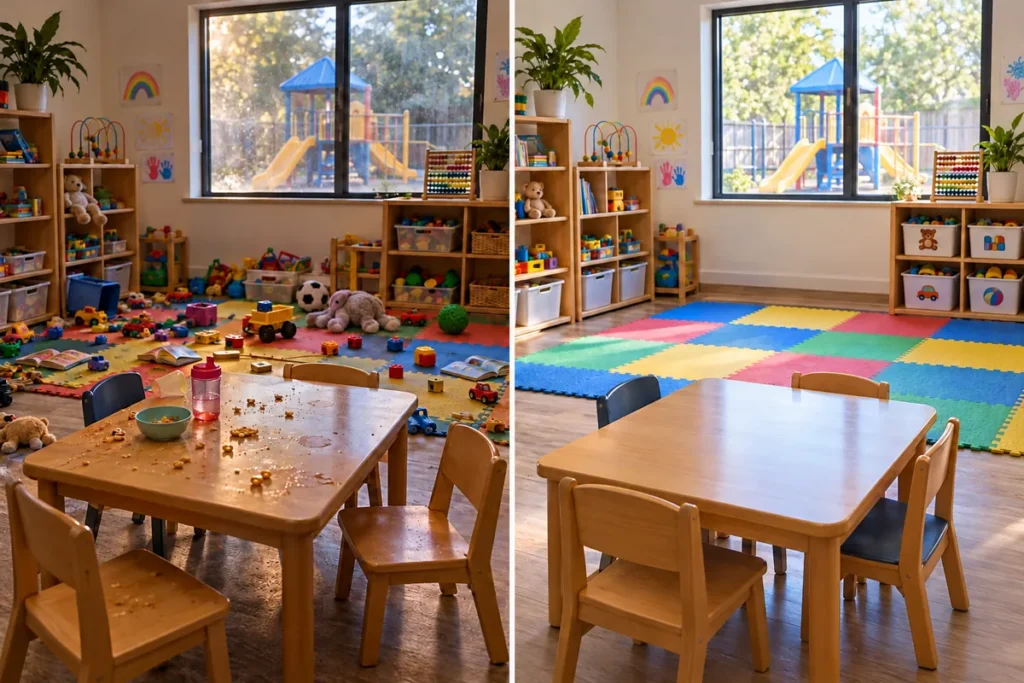
- Floors washed. Carpets and rugs vacuumed while children aren’t in the room.
- Tables, counters, light switches, door handles and cabinet handles cleaned and disinfected.
- Garbage emptied.
Toys and mouthed items
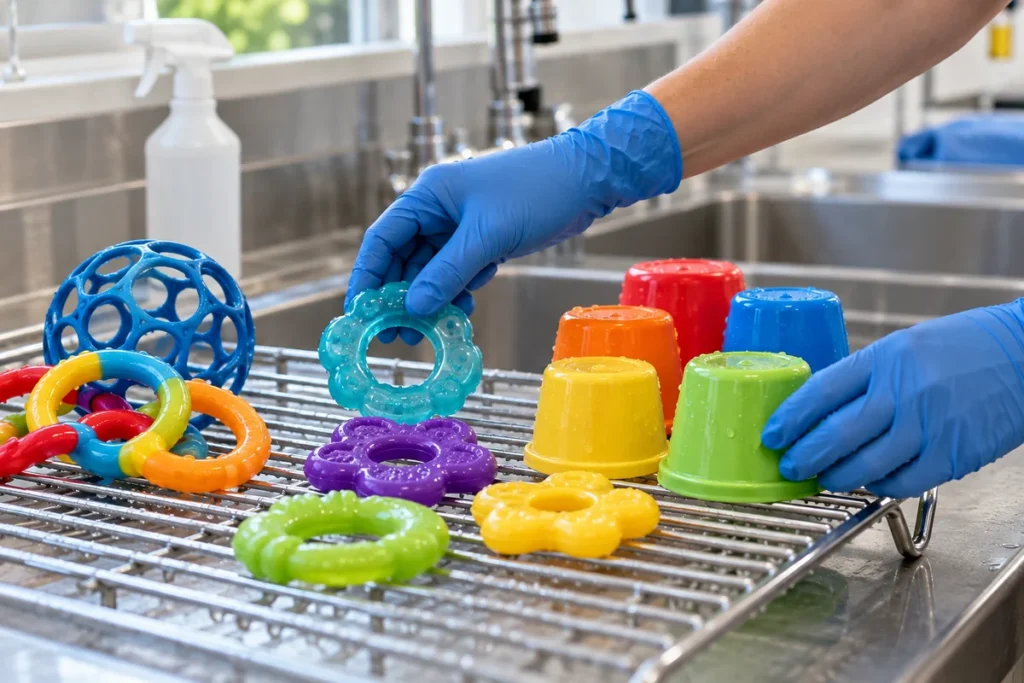
- Mouthed toys go into a labelled bin right away. Clean, disinfect and rinse them before another child uses them.
- Water tables and water toys: drain, clean, disinfect and dry. PHO says after each use. Alberta Health Services (AHS) says between each group of children or at least twice a day, and its Appendix G schedule names midday and end of day. Island Health (BC) says daily, if used that day.
- Sand table toys cleaned and disinfected (AHS: daily).
- Other toys: daily in Ontario under the PHO schedule.
Washrooms and diaper change areas
- Potty seats, toilet inserts and diaper change mats cleaned and disinfected after each use.
- Change table surface cleaned and disinfected after each child (AHS), with a full clean at least daily (PHO).
- Toilets, sinks, taps and the counters around them cleaned and disinfected.
- Diaper containers emptied.
Eating areas and kitchen
- Tables and high chair trays cleaned and sanitized before and after eating.
- Food prep surfaces sanitized before and after use, and between raw and ready-to-eat foods.
Weekly daycare cleaning checklist
- Other toys, play mats, riding toys and activity centres cleaned and disinfected. Alberta and Manitoba say weekly; Ontario’s schedule says daily.
- Cots, cribs, mattresses and bedding: linens laundered weekly, and before another child uses them.
- Crib rails, shelves and infant- and toddler-level furniture cleaned and disinfected twice a week (AHS).
- Chairs cleaned and disinfected. Upholstered furniture vacuumed.
- Plush toys and dress-up clothes laundered.
- Garbage containers cleaned and disinfected.
- Phones and computer keyboards cleaned and disinfected. Manitoba says use a wipe, don’t spray.
- Child-level windowsills and toy shelves damp-wiped (Manitoba).
Monthly and periodic tasks
- Cubbies, door ledges and shelving cleaned.
- Air vents and drapes vacuumed.
- Refrigerator and oven cleaned out.
- Carpets deep cleaned on your province’s cycle.
- Windows about twice a year (AHS).
Carpet is where the documents disagree most. AHS calls for a deep clean at least monthly in infant areas and at least every three months elsewhere. Manitoba says shampoo every three months. PHO’s schedule lists a steam clean at least twice a year. Whichever cycle applies, keep children off the carpet until it’s dry. Our guide to commercial cleaning and indoor air quality explains how dust builds up in carpet between deep cleans.
How to clean up blood, vomit and other body fluids
Keep a spill kit where staff can reach it fast. BCCDC encourages one, and its guideline on gastrointestinal illness outbreaks in child care facilities lists what goes in it: disposable gloves, a gown, eye protection, a procedure mask, a bucket, a mop, leak-proof bags, single-use towels, detergent and disinfectant.
The procedure in that guideline and in Manitoba’s Routine Practices guide runs like this:
- Keep children and staff away from the area, and put on gloves.
- Wipe up most of the spill with disposable towels, working from the least soiled edge in, and bag them.
- Clean the area with detergent and water, rinse and dry.
- Disinfect with a product suited to the surface and leave it wet for the contact time.
- Bag gloves and everything used. Wash and disinfect reusable gloves, and launder or disinfect the mop head and bucket.
- Bag soiled clothing to send home. Don’t rinse it at the centre.
- Wash your hands and restock the kit.
AHS adds one difference: blot spills with paper towels or disposable cloths rather than a mop, because mops are hard to clean properly afterwards.
Bleach strength for body fluid spills
Strength matters here. The AHS guide uses 1 part household bleach to 9 parts water for body fluid spills, with at least 10 minutes of contact. Island Health’s sanitizer information sheet for licensed child care also uses a 1:10 solution for surfaces soiled with urine, stool, mucus, vomit, blood or nasal discharge. On carpet, AHS suggests a non-staining disinfectant or steam cleaning. Manitoba requires steam cleaning and disinfection after a blood or body fluid spill.
Those ratios only work if your bottle matches what the guide assumes. AHS Appendix I specifies household bleach at 5.25% sodium hypochlorite for the 1:9 mix, and Island Health’s sheet uses the same 5.25% figure. Many store bottles now run from 3% to 8%. Read the percentage on the label, adjust the mix if your public health guide gives a ppm target, and confirm the final strength with test strips before use.
How to clean toys: dishwasher, washing machine or by hand
Pick the method by material.
Hard plastic toys can go through a dishwasher. AHS accepts a commercial model, or a domestic one with a sanitizing cycle that a public health inspector has tested. Manitoba says to run toys separately from dishes and cutlery. BCCDC’s cleaning and disinfecting page says dishwasher-safe hard plastic toys can be cleaned and disinfected with a hot rinse cycle.
Plush toys belong in the washing machine. AHS doesn’t allow shared stuffed toys unless they can be machine washed and then dried in a hot dryer cycle. Manitoba says to launder plush toys at the hottest temperature allowed.
For everything else, AHS sets out a hand method:
- Wash with detergent and warm water.
- Rinse with clean warm water.
- Wipe, spray or submerge in an approved sanitizer for 2 minutes.
- Air dry.
- Rinse with potable water if the toy is likely to be mouthed.
AHS also wants a separate sink for toys. It can’t be a handwashing sink or a washroom sink.
Cloths, mops and buckets
Reusable cloths and mops carry soil from one area to the next. Manitoba’s guide gives the clearest rules. Clean from the least soiled area to the most soiled. Colour-code reusable cloths, cleaning tools and rubber gloves so washroom equipment never reaches the kitchen. Keep mops and brooms clean and dry, and launder a mop that’s visibly dirty from blood or vomit after use. Use disposable cloths where you can.
Manitoba’s cleaning steps also start with a clean cloth and a pail of fresh hot water and soap. In practice, a used cloth never goes back into the clean solution. Grab a fresh one.
Put the separation in your cleaning plan: which colour goes with which area, and where each set is stored. Then the same rule holds whether staff or a contractor does the work.
For laundry, PHO’s IPAC checklist says cleaning cloths and mop heads are laundered separately from linens, dress-up clothes and face cloths. AHS lists mops and cleaning rags for cleaning and disinfecting after a day of use or as needed.
Daycare cleaning rules by province
Ontario (Toronto, Ottawa, Kitchener–Guelph–Hamilton)
PHO’s one-page Child Care Centre Cleaning and Disinfection Schedule lists each item against after each use, daily, weekly and other. It sets “other toys” at daily, where Alberta and Manitoba say weekly. Pair it with the IPAC checklist and check with your local public health unit, since O. Reg. 137/15 requires licensees to carry out any direction from the medical officer of health (s. 32). We clean daycares in Toronto, Ottawa and Kitchener–Guelph–Hamilton.
Alberta (Calgary)
The AHS Health and Safety Guide for Operators of Child Care Facilities (April 2025) has the full schedule in Appendix G, approved sanitizers in Appendix F, outbreak disinfection in Appendix C and the spill procedure in Appendix I. During outbreaks it raises bleach from 100 ppm for routine sanitizing to 1,000 ppm (see outbreak cleaning below). Our Calgary office covers Alberta centres.
Manitoba (Winnipeg)
Manitoba’s Routine Practices guide makes it the facility’s job to develop a cleaning schedule and name who does each task. Its schedule tables run from “before and after each use” to monthly, and it’s the source of the colour-coding advice above. See our Winnipeg page for local service.
British Columbia (Vancouver and the Lower Mainland)
BC’s Child Care Licensing Regulation requires the facility, furniture, equipment and fixtures to be clean and in good repair while children attend (s. 13(2)). The regulation doesn’t list frequencies, so look to health authority guidance.
Island Health’s sheet was written for licensed child care on Vancouver Island and gives item-by-item frequencies. Diaper change areas and toilet seats: after each use. Mouthed hard toys, toilets, washable floors and used water tables: daily. Sleep mats, doorknobs and light switches: weekly. Hard toys, chairs and tables: monthly. Bedding is laundered weekly and stuffed animals monthly.
BCCDC’s outbreak guideline adds that hard surface toys should be cleaned and disinfected daily or more often. During an outbreak, a full clean at night or over a weekend may be needed. In the Lower Mainland, Fraser Health’s licensing team inspects facilities on hygiene and communicable disease control, among other categories. Ask your licensing officer, at Fraser Health or Vancouver Coastal Health, which schedule they expect. Local service details are on our Vancouver and Lower Mainland pages.
Outbreak cleaning
When more children or staff than usual share the same symptoms, treat it as a possible outbreak and follow your local public health instructions. AHS’s operators’ guide says disinfectant concentrations go up during an outbreak. Appendix C sets household bleach at 1,000 ppm (about 1/3 cup of 5% bleach in 4 litres of water, made fresh each day). The same appendix allows a Health Canada DIN product with a norovirus claim for gastrointestinal outbreaks, or a broad-spectrum virucidal claim for respiratory ones.
AHS also asks centres to step up cleaning of high-touch surfaces and post a cleaning log in shared spaces. Shared toys and water or sand tables that can’t be cleaned between groups should be pulled. BCCDC’s gastrointestinal illness outbreak guideline says hard-surface toys should be cleaned and disinfected daily or more often, and that a full clean overnight or over a weekend may be needed. Report suspected outbreaks to your public health unit and keep the signed cleaning log with the centre’s records. For a rapid-response clean, see our disinfection services.
Who does what: staff or contractor
Educators can’t wash every floor while parents are still in the hallway. A crew isn’t on site at 10 a.m. to disinfect a change table between two diapers. Split the list by time of day.
| Task | During the day (staff) | After hours (crew) |
|---|---|---|
| Change mats, potty seats | After each use | Full clean and disinfect at end of day |
| Mouthed toys | Pulled, cleaned, disinfected, rinsed | Only if toys are in the contractor’s scope |
| Eating tables, high chairs | Before and after eating | Final clean at close |
| Floors and carpets | Spot clean spills | Wash, vacuum, periodic deep clean |
| Washrooms | Spot checks, restocking | Full clean and disinfect, restock |
| High-touch points | Extra wipes during outbreaks | Daily clean and disinfect |
| Garbage | As needed | Empty daily, wash bins weekly |
Write down what the crew should leave alone, too: children’s artwork and labelled personal bins, for example. Everest schedules daycare cleaning after the last pickup and lock-up, so crews don’t work during program hours. Toys and kitchenettes are cleaned only when they’re listed in the quotation.
For how the evening shift itself runs, including access, alarm codes, chemical lock-up and the morning handover, read our guide to after-hours daycare cleaning. If you’re still choosing a provider, start with how to choose a daycare cleaning company.
Daycare cleaning log template
A schedule shows what should happen. A log shows what did, and that’s the record an inspector can check. AHS recommends a posted cleaning log during outbreaks in shared spaces and suggests checklists for routine maintenance.
| Date | Area or item | Task | Product and dilution | Time | Initials | Notes |
|---|---|---|---|---|---|---|
| Infant room change table | Clean + disinfect | |||||
| Toddler room toys | Clean + disinfect + rinse | |||||
| Washrooms | Clean + disinfect, restock | |||||
| Water table | Drain, clean, disinfect, dry | |||||
| Bleach solution | Test strip check |
Printable daycare cleaning checklist
The routine column is the baseline the provincial documents share. The last column shows where a province sets something different or extra.
| Area or item | Routine frequency | Periodic / province-specific |
|---|---|---|
| Potty seats, toilet inserts, change mats | After each use | Change table surface: after each child (AB); full clean daily (ON) |
| Mouthed toys | After each use, then rinse with potable water | |
| Water table and water toys | After each use: drain, clean, disinfect, dry | ON (PHO): after each use. AB: between groups or at least twice a day (Appendix G: midday and end of day). BC (Island Health): daily if used |
| Eating tables, high chairs | Clean, then sanitize, before and after eating | Food-contact sanitizing (not bathroom-strength disinfectant) |
| Toilets, sinks, floors, high-touch points | Daily | Increase during outbreaks |
| Other toys | Weekly (AB, MB) | ON: daily. BC (Island Health): hard toys monthly |
| Carpets and rugs | Vacuum daily | Deep clean: AB monthly in infant areas and at least every 3 months elsewhere; MB shampoo every 3 months; ON steam clean at least twice a year |
| Crib rails, infant-level furniture | Weekly | AB: twice weekly |
| Bedding, plush toys, dress-up clothes | Weekly | Sooner if shared or soiled. BC (Island Health): stuffed animals monthly |
| Garbage containers | Empty daily, clean and disinfect weekly | |
| Cubbies, vents, drapes, fridge, oven | Monthly | Windows: about twice a year (AB) |
Daycare cleaning questions
How often should daycare toys be cleaned?
Mouthed toys are cleaned and disinfected after each use, then rinsed with drinking water. Other toys depend on the province: Public Health Ontario’s schedule says daily, while Alberta Health Services and Manitoba’s guide say weekly. In every province, clean a toy right away when it’s visibly dirty.
What is the difference between sanitizing and disinfecting?
Sanitizing lowers germs to a safe level and is mostly used on food contact surfaces such as tables and high chairs. Disinfecting kills more germs and goes on washrooms, change areas and surfaces soiled with body fluids. Both only work on a surface that has been cleaned first.
What disinfectant can daycares use in Canada?
Use a product with a Health Canada Drug Identification Number (DIN), mixed and applied exactly as the label says, contact time included. Provincial guides also accept diluted household bleach at set strengths, checked with test strips. Your public health inspector can confirm which products and concentrations they expect.
How should a daycare clean up vomit or blood?
Keep children away, put on gloves and wipe up most of the spill with disposable towels. Clean the area with detergent and water, then disinfect it and leave it wet for the contact time. Bag everything used, launder or disinfect the mop and wash your hands.
Who is responsible for cleaning in a licensed child care centre?
The licensee. In Ontario, O. Reg. 137/15 makes the licensee responsible for operating and managing the centre, and BC’s Child Care Licensing Regulation requires the licensee to keep the facility and equipment clean. A contractor can do the work, but the licensee still answers for it at inspection.
Is there a daycare cleaning checklist PDF I can print?
Public Health Ontario publishes a one-page Child Care Centre Cleaning and Disinfection Schedule as a PDF. Appendix G of the Alberta Health Services operators’ guide is a full schedule. You can also copy the printable checklist and the cleaning log template in this article.
Hand the after-hours part to a crew
Everest cleans daycares after closing from offices serving Toronto, Ottawa, Kitchener–Guelph–Hamilton, Calgary, Winnipeg and Vancouver and the Lower Mainland. A free site assessment is the place to agree which parts of this checklist the crew covers, including whether toys and high-touch surfaces are in scope. We send a written quote within 1 business day.