Commercial entrance matting works when it strips grit and water off shoes before they reach the hard floor. That takes the right mat at the right door, laid flat, and cleaned or swapped before it soaks through. In Vancouver the wet season brings rain and mud every day, so the mats are the first thing to give out.
The focus here is the mats themselves: which type goes where, how far the run needs to reach and what goes wrong. Cleaning mats in place is part of our winter floor care services, and the floor around the mat is covered further down.
What does an entrance mat have to do?
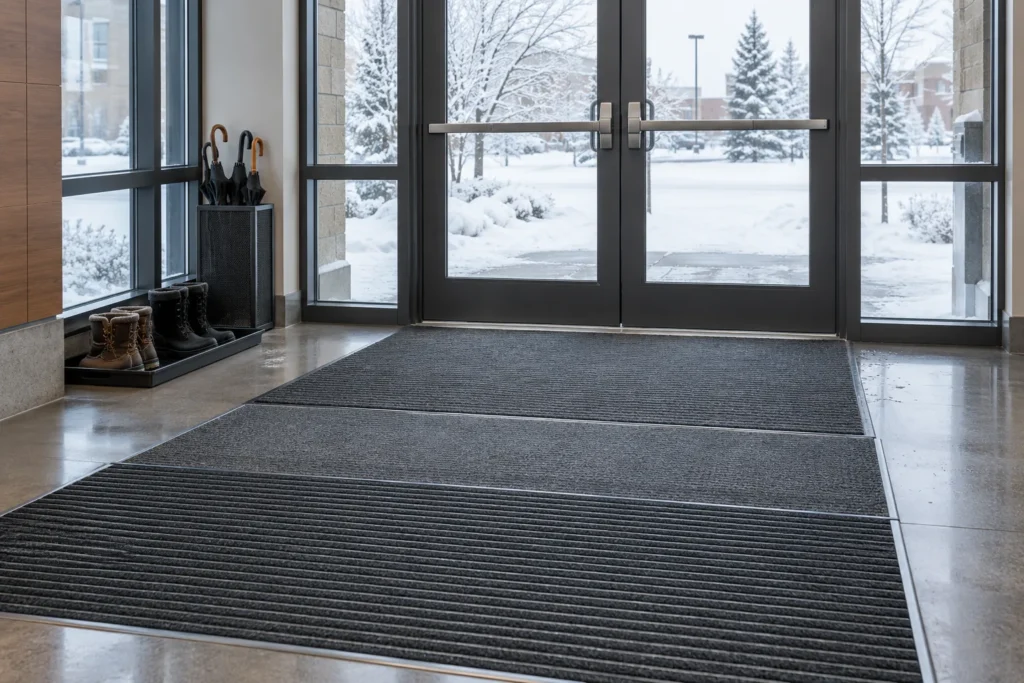
Two jobs. It scrapes grit off the sole, and it soaks up water. One mat rarely does both well, which is why a good entrance has a scraper outside and an absorbent mat inside.
Grit is the quiet damage. It wears finish off hard floors and grinds into carpet, so it matters even on days when nobody slips. Water is the visible risk, because a wet tile lobby is slippery before anyone has time to notice.
Which mat goes where?
| Position | Job | What to look for |
|---|---|---|
| Outside the door | Scrape off mud and grit | A rugged, open surface that lets water drain through. It sits flat or in a recess, so the door does not catch it. |
| Just inside the door | Absorb water | A fabric surface that holds moisture, with a backing that stays put on tile and does not slide under a wheelchair or a cart. |
| The turn toward the lobby | Catch what the first mat missed | A second absorbent mat where the route carries on, especially if people head for an elevator or a front desk. |
How long should the mat run be?
Long enough that people take several full steps on it with both feet. No single length fits every building, because it depends on how people walk in. A straight line from a revolving door asks for more mat than a lobby where visitors turn at once toward reception.
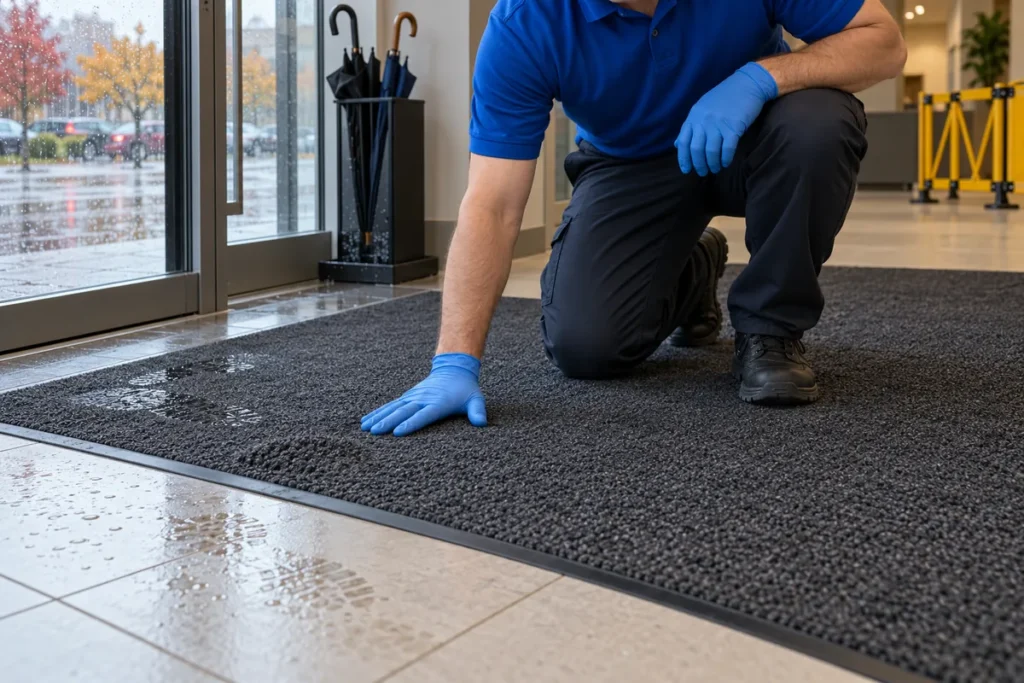
For a figure, ask the mat maker for its guidance on your product, or check the Canadian Centre for Occupational Health and Safety slip guidance linked in our rainy season office cleaning guide. Then test it on site. On a wet morning, mark where the wet footprints stop. That spot is the real end of the useful run.
Placement mistakes that let water through
- Curled corners and rolled edges that catch a toe or a wheel
- A gap between the mat and the door sill, where water runs straight past
- A mat that stops a step short of the lobby tile, so wet shoes land on polished floor
- Mats stacked or overlapped to fill a gap, which makes a ridge
- A mat sized for the door frame but not for the way people actually walk
- Backing that slides on smooth tile when the mat is wet
These tend to show up once heavy rain starts. A five-minute walk of every entrance, before the season starts, finds them cheaply.
How often should mats be checked and cleaned?
Set the check by the weather, not the calendar. On a heavy rain day a mat can be saturated by mid-morning, and a saturated mat spreads water instead of stopping it.
The test is simple. Lift a corner and press. If water comes out, or the backing is wet through, the mat is finished until it is swapped or dried. Loose dry grit can be vacuumed, but vacuuming does not dry a soaked mat.
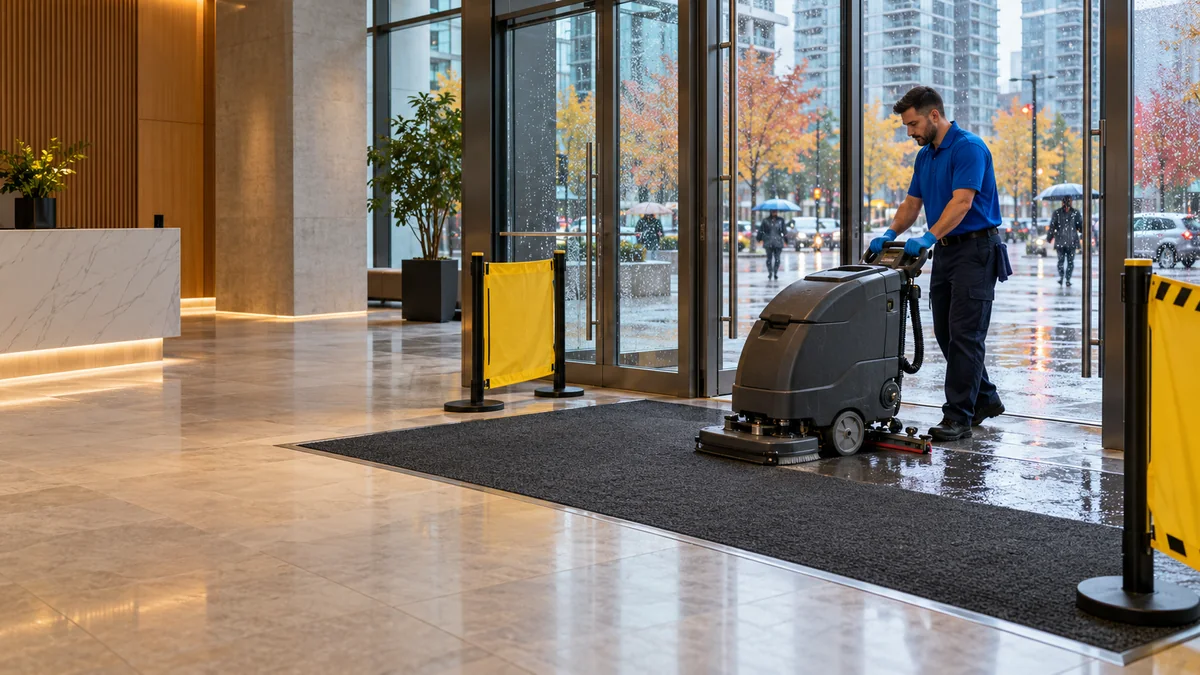
Our crews clean entrance mats in place on a written schedule, and ride-on scrubbers handle the hard floor beside them on larger lobbies. If a rental company supplies your mats, ask how a swap works in a wet week. Put the answer in writing.
The floor around the mat
A mat only helps if the floor beyond it stays dry enough to walk on. Three spots need attention: the first stretch of tile past the mat, stair nosing just inside the door, and the threshold itself.
Polished stone and glazed tile are the slipperiest when wet. If the lobby has either, the mat run matters more, and a quick pass with a dry mop at the edge of the mat can save a fall. A wet-floor sign tells people to take care. It does not take the water off the floor.
For broader floor care through the season, see our guide to winter floor care for commercial buildings. Our page on commercial building cleaning services lists what a lobby and common-area schedule can include.
Salt marks on carpet near the door are a separate problem. We cover it in how to remove salt stains from commercial carpet.
A one-page mat plan
- List every door staff and visitors use, including the parkade door and the loading entrance.
- Note the mat type, size and condition at each one.
- Walk each route on a wet morning and mark where footprints stop.
- Name who checks mats during occupied hours, and how they report a soaked one.
- Write the clean or swap trigger into the cleaning scope: wet through, not a day of the week.
- Photograph each entrance once a month so wear shows up early.
What to do on the day a mat fails
Even a good plan has a bad hour. When a mat is soaked, take it out of the walking line and put down a dry one if you have a spare. If you have no spare, lay absorbent towels or a temporary runner along the edge, and mark the wet patch with a sign until the floor is dry.
Then tell whoever sets the cleaning schedule. A mat that fails twice in a week points to a run that is too short or a schedule that is too thin. The fix belongs in the written scope, not in a one-off note.
Frequently asked questions
How many entrance mats does a commercial building need?
At least one at every door people use, and usually two in a row: a scraper mat outside and an absorbent mat inside. Count the side and parkade doors, not only the front lobby. A walk on a wet morning shows where a third mat is needed.
Where should entrance mats go in a lobby?
Directly inside every door, laid flat and square to the traffic line, with the far edge reaching the tile the route continues over. Add a second mat where people turn toward an elevator or desk. Keep mats clear of door swings and stair edges.
Should mats be inside the door only, or outside too?
Both, where the door allows it. An outside scraper mat takes the mud and gravel before it reaches the building, and the inside mat then has only water to deal with. If there is no sheltered outside spot, lengthen the inside run.
How often should entrance mats be swapped or cleaned in wet weather?
When they are wet through, not on a fixed day. Check mats during occupied hours on rainy days and keep a swap or cleaning trigger in the written scope. Dry grit can be vacuumed daily. A soaked mat needs to be swapped or cleaned in place.
What makes a wet entrance floor slippery even with a mat?
A saturated, curled or too-short mat, or one that stops before the tile does. Smooth stone and glazed tile stay slick underfoot even with light moisture. Clear spills promptly, mark wet areas and keep a dry route open.
Get your entrances looked at
Send us the number of doors, the floor types inside them and where the mats sit now. We scope the work from that, then confirm at a free site assessment if the building needs it. See winter floor care services or commercial cleaning in Vancouver, or get a free quote and we will send a written quote within 1 business day.