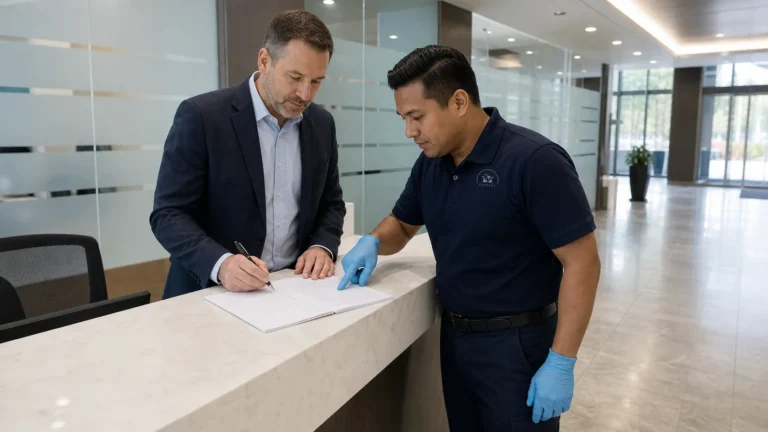

A commercial cleaning inspection works best as a short, repeatable walkthrough. Follow the same route each time, check every area against the written scope, mark each line as a pass, a miss or not in scope, and send the misses to one named contact the same day. A sensible starting rhythm is weekly for the first month with a new provider, then monthly.
This guide is for office, facility and property managers who hire a cleaning company and want to know whether the work matches the agreement. It follows on from how often an office should be cleaned and day porter vs night cleaning. Once the schedule is set, the next question is how you check that it is being delivered.
Who carries out a commercial cleaning inspection?
Three kinds of checks sit side by side, and they do different jobs:
- The provider’s own inspections. A supervisor checks the crew’s work on a routine. Ask how often, and how the results are recorded.
- Your walkthrough. This is the routine in this article. You see the building the way your staff and visitors do.
- A joint walkthrough. You and the supervisor walk the space together. It is most useful in the first month and again at each quarterly review.
None of these replaces the others. Your walkthrough is the only one that shows what staff actually experience on a Tuesday morning.
Start your commercial cleaning inspection from the written scope
Inspect against the agreement, not against a general impression of “clean.” If the scope says washrooms are cleaned nightly and the kitchen counters are wiped nightly, you can check both. If the scope says “keep the office looking professional,” there is nothing to measure, and the first fix is a better scope.
Keep the scope in your hand during the walk. What commercial cleaning includes separates the nightly route from extras and from tasks that are usually left out, which helps you avoid scoring the crew on work that was never booked. Carpet extraction, window cleaning and strip and wax run on their own dates, so check those on the date they are due rather than on the routine route.
When to inspect
- First month with a new provider: weekly, with the supervisor present for at least one walk.
- After that: monthly, plus after a move, a renovation, an event or a change in headcount.
- Time of day: early, before staff arrive, so you are looking at the previous night’s work. Vary the day of the week so you see a typical result rather than a best-case one.
- Daytime coverage: if you also have a day porter, check those areas mid-afternoon as a separate pass.
These are starting points, not rules. A busy lobby may need a weekly look all year, while a quiet private-office floor may be fine monthly.
A walkthrough route for your commercial cleaning inspection
Walk the same route each time, in the same order, so month-to-month results are comparable. Use the table as a starting point and adjust it to your building and scope.
| Area | What to check | Signs of a miss |
|---|---|---|
| Entrance and lobby | Mats lying flat, entry glass at hand height, floor along the door line | Grit or salt at the threshold, smeared glass, a bunched or saturated mat |
| Reception and corridors | Floor edges and corners, carpet traffic lanes, handles, rails and buttons | A dust line along the baseboards, debris in corners, fingerprints on touch points |
| Open-plan office and meeting rooms | Floors around and under desks, table tops, bins | Crumbs by chairs, ring marks on tables, bins not emptied or liners missing |
| Kitchen and break room | Sink, counters, appliance exteriors, floor under tables, bin | Residue in the sink, sticky counters, odour from the bin |
| Washrooms | Fixtures, mirrors, floor around the base of toilets, dispensers, bins | Water spots, dust at floor edges, empty dispensers, lingering odour |
| Stairs and elevators | Stair edges, handrails, elevator floor and plates | Dirt along tread edges, smudged rails |
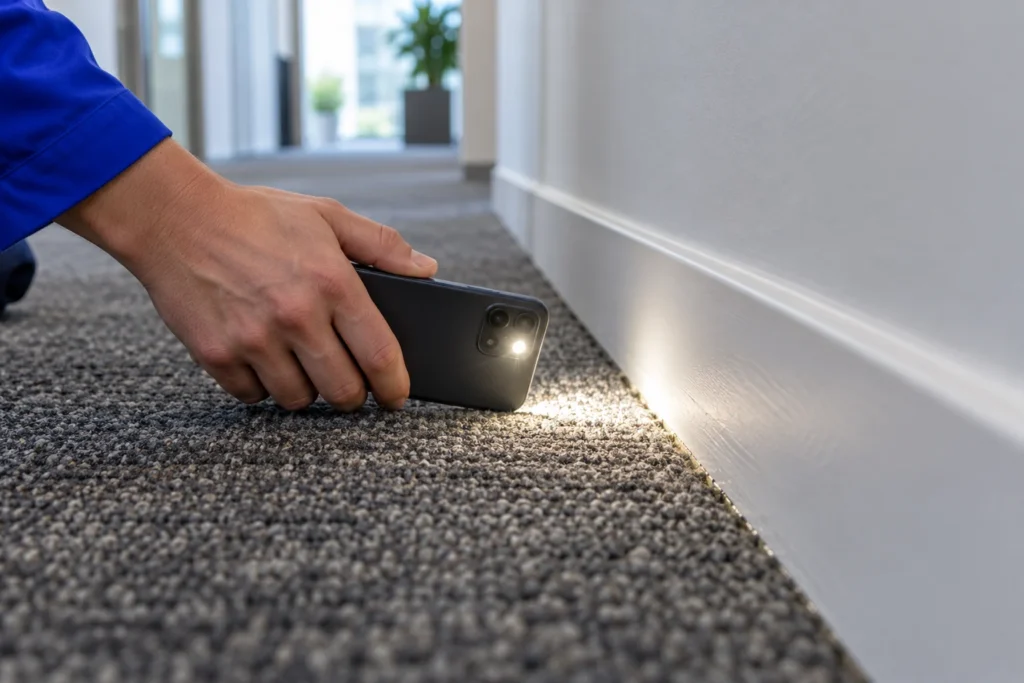
Get low and look along the floor. Edges, corners and the base of walls show build-up before open floor does, and a phone torch held at a low angle makes streaks and dust easier to see. Open the doors you can, and look behind them. Take a dated photo of anything you score as a miss.
Score what you find
“Looks fine” and “looks bad” are hard to act on. A short rating scale keeps the walkthrough consistent and gives the provider something specific to fix.
| Rating | What it means | What to do |
|---|---|---|
| Pass | The task was done to the written scope | Note it and move on |
| Minor miss | The task was done, but not to standard (a streak, one spot missed) | Include it in your routine report and recheck next visit |
| Missed task | A written task was not done (bins not emptied, a washroom skipped) | Report the same day with a photo and ask for a fix date |
| Safety or hygiene issue | A hazard such as a wet floor with no sign, damaged flooring or a spill | Tell your building or safety contact first, then the provider |
| Not in scope | The task is not in the agreement | Do not score it; decide whether to add it |
Some facilities teams borrow a shared vocabulary from APPA, whose five appearance levels run from Level 1, Orderly Spotlessness, to Level 5, Unkempt Neglect. The levels were written for educational facilities. Level 2, Ordinary Tidiness, allows up to two days’ worth of dust, dirt or streaks on floors, and one university’s janitorial solicitation uses Level 2 guidelines for entrances, corridors, offices and meeting rooms. If you adopt a level, write it into the agreement so both sides mean the same thing.
A visual check also has limits. A study of cleaning verification in healthcare settings notes that visual inspection is the traditional method and that an inspector’s eyesight affects the result, which is why ATP tests are used there. For a typical office, a consistent walkthrough against the scope is the practical approach. If your building has stricter requirements, such as a clinic or daycare, agree any extra verification in the contract.
Know whose job a miss is
Not every problem you find belongs to the cleaning crew. Sorting this out first keeps the conversation with your provider fair and short.
| What you see | A cause outside the cleaning scope | Who to tell |
|---|---|---|
| Cluttered desks or floors left untouched | Items not cleared before the crew arrived | Your staff or office manager |
| Empty soap or paper dispensers | Unclear supply arrangements | Whoever orders supplies; agree who stocks what |
| A room that was not cleaned | The crew could not get in | Whoever manages keys and access |
| A wet or gritty entrance mid-day | Weather between visits | Consider mats or daytime coverage |
| A leak, a burnt-out light or damaged flooring | Building maintenance | Your building manager |
Housekeeping inspections also look for hazards, not just dirt. The CCOHS housekeeping inspection checklist includes items such as spills, worn flooring and lighting, so treat those as safety reports rather than cleaning complaints.
How to report a miss so it gets fixed
- Report it the same day. A miss reported on Tuesday can be fixed on Wednesday. One reported three weeks later is an argument about memory.
- Put it in writing and send it to one named contact at the provider.
- Be specific. Give the room, the task as the scope words it, what you saw and a dated photo.
- Say what you want and by when. For example, a re-clean by the next visit.
- Keep a log. Record the date, area, issue, when you reported it and when it was fixed.
Example wording: “Level 3 washroom, Tuesday, 7:40 a.m. The soap dispenser is empty and the floor around the toilet base is marked. Photos attached. Please confirm the fix by tomorrow’s visit.”
Review the pattern, not just the miss
One missed night is not a reason to change providers, but a pattern is. Your log shows the difference. If the same washroom fails every second week, the cause may be a thin scope or too few visits rather than carelessness, and the fix may be an extra visit or a day porter for that area.
Read the log with the supervisor monthly, and review the scope and frequency each quarter or when headcount changes. If a pattern continues after you have reported it clearly, the guide to switching commercial cleaning companies explains how to document it and read your contract before you give notice.
Frequently asked questions
How often should I inspect my commercial cleaning?
Weekly for the first month with a new provider, then monthly is a reasonable starting point. Add extra checks after events, renovations or a change in headcount. If you cannot be on site early, give a colleague the same route and rating scale so results stay comparable.
Should I tell the cleaning company before I inspect?
Both approaches have a place. Joint walkthroughs build the working relationship and suit the first month and quarterly reviews. Routine solo walkthroughs show the typical result. Because crews often work after hours, your morning check is usually a look at the finished work rather than a surprise visit.
What if I cannot tell whether a task was done?
Ask what records the provider keeps, such as task checklists or inspection notes, and agree in the contract which ones you will receive. A written scope plus a record of completed tasks is easier to check than either one alone.
Get a scope you can inspect
A scope you can check is easier to manage than a general promise. Tell us about your rooms, floor types and hours, and we can walk the space with you and put the scope in writing. Request a free estimate, or see how our office cleaning service works.