The owner walkthrough is at nine. The GC closed the punch list at eleven the night before. Someone lifts a return-air grille in the new boardroom and a sheet of drywall dust drops onto carpet that still has the mill tag on it. That is the job this post-construction cleaning checklist is for.
If you’re the PM reading this on site wifi, skip ahead to vents and floors. In my experience, those two items reopen more “we already cleaned” tickets than anything else. The rest of the list still matters.
This isn’t a weekly janitorial spec. If you want that, see what commercial cleaning includes. Here, the trades have left and the poly is down, or should be. You need the building presentable for occupancy, a landlord walk, or substantial completion under a CCDC-style contract. Everest books this work through our post-construction cleaning page. This post is the walk-through we actually use on the floor.
What has to be true before you start
- The dust source is finished. Don’t send a crew while drywallers are still sanding two floors up. Fine dust will re-settle on every sill you just wiped.
- The HVAC construction filter is still in place. If the mechanical contractor installed one, it should stay until the last sanding pass. I can’t see the air handler from the corridor, so I ask. If nobody knows, write it down as an open item. Don’t pretend a wipe of the grille cleaned the system.
- Access works. Keys, fobs and alarm codes need to work on the spaces you expect us to enter. A locked server closet, a pharmacy cage or a tenant suite that isn’t on the ticket stays shut. We note it. We don’t invent access.
Dust: the part that comes back
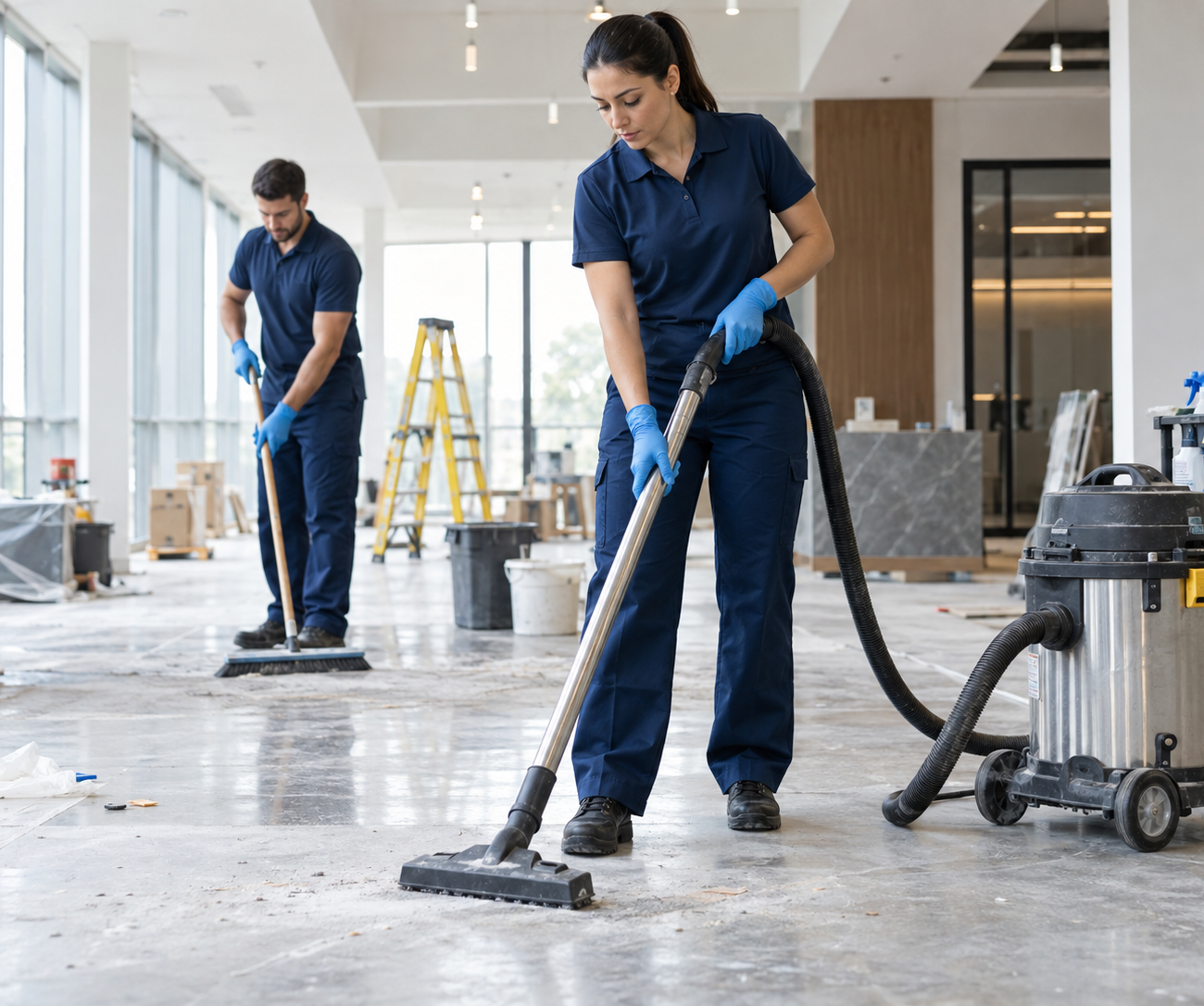
Drywall dust isn’t the pile on the floor. That pile is easy. The problem is the film on the top edge of every door frame, inside switch and receptacle boxes once the plates are off, on the back of T-bar, on the top of cabinets and in the track of every sliding window. A shop vac without a HEPA filter just moves that film into the next room.
- HEPA vacuum horizontal surfaces from high to low, then the floors.
- Change the filter when suction drops. A clogged HEPA is a blower.
- Wipe sills, frames, base and the tops of doors after the vac pass. One wipe isn’t enough on a sanded floor.
- Check a sample of electrical boxes while the plates are still off. If the box is white inside, the wall cavity dumped into it. Dust inside a box is for the electrician to clear. We don’t work inside live boxes.
- Lift a few T-bar tiles near the returns. If the back of the tile is furred, the ceiling plenum took the sanding.
- If poly, zip walls or floor protection are still up, stop. Cleaning around poly leaves a dirty outline the owner will find.
If millwork still has film on it, we pull it and wipe. If staff have already moved in and left papers, we clean around them.
Overspray, tape and trade residue
Paint overspray shows up on glass, hardware, stainless elevator frames and anodized aluminum. Blue tape leaves adhesive that looks like dirt until you hit it with the right solvent. Caulk smears sit on vinyl base for weeks if nobody checks the first coat.
- Glass and mirrors: scrape where the paint is dry, then wash. Don’t grind grit across a new lite.
- Door hardware and lever sets: wipe the rose and the latch face. Overspray there reads as a cheap install.
- Elevator frames and stainless: approved stainless cleaner only. No abrasive pads on a #4 finish.
- Anodized storefront: skip aggressive solvents and test a low corner. A haze you can’t buff out is a warranty call, not a cleaning win.
- Tape residue on glass, base and millwork: floor protection tape is worse than painter’s tape. Budget time for it.
- Label stickers on appliances, fire extinguisher cabinets and new fixtures: peel and de-gum them. Leave code labels that have to stay.
Grout haze on new tile goes back to the trade if a test wipe won’t lift it. The same goes for adhesive that squeezed out under LVP.
Vents and the first length of duct
Supply and return grilles collect the same fine dust as the sills. We pull them, wash them, and vacuum what we can see in the first stretch of duct, usually the first 20 to 30 centimetres. That’s not a full duct clean. If the mechanical spec called for a duct wipe or a filter change at occupancy, that’s the HVAC contractor’s line unless you put it on our scope in writing.
If the construction filter is black and the grilles film over again an hour after we leave, the unit is still throwing dust. That’s mechanical. We can come back after they change it.
On the list:
- Every supply and return we can reach without a lift beyond the ticket
- Thermostat faces and occupancy sensors, which film over and then look “broken”
- Transfer grilles in doors, which people forget
- Bathroom fans and their grilles, not the rooftop stack
Floors: where most tickets reopen
Floors fail because someone let carts roll, or because the crew treated every surface like VCT. Sealed concrete, polished concrete, VCT, sheet vinyl, LVP, ceramic and broadloom each take a different last pass. A burnisher on the wrong floor leaves a haze you’ll own.
- Start with a sweep or a HEPA vac. Dust left under a mop turns into mud and a second day.
- Do the expansion joints and saw cuts. They hold pellets of drywall and screw caps, and a flat mop skips them.
- Put clean mats at the entry before the last wet pass, so you don’t track the parking lot back in.
- VCT and sheet vinyl: strip only if the spec says so. A post-construction pass is often a scrub and a coat, not a full strip. Confirm. Our guide to when to strip and wax floors explains the difference.
- Carpet: hot water extract after the dry soil is out. Don’t soak a floor that still has no heat on in January.
- Concrete: dust mop, then use the cleaner the floor finish allows. Don’t leave a polymer film on a floor the owner wanted raw.
How many days a floor needs is the question I won’t answer from a photo. A 4,000-square-foot clinic with new VCT and a warehouse with sealed slab are different jobs. Walk it. Count the rooms that still have floor protection down. That number is the schedule.
The punch list is the job
We work from the GC punch list and the rooms you open. A generic “construction clean” with no list is how leftover paint cans, ladder dents in the base and a missed washroom get found by the owner at 9:05. We photograph what we can’t move. Trade debris that’s still a trade’s problem stays, and we write the room number.
Walk the list room by room. Check each line off, or write why it’s still open.
- Washrooms: fixtures, stalls, mirrors and floors. Stock paper and soap if you left it where we can reach it.
- Kitchens and staff rooms: inside new appliances if the film is still on. Not last week’s leftovers if staff have already moved in.
- Stairs, landings and the elevator cab: the cab collects overspray and grit from every floor.
- Exterior glass at entries, if it’s on the ticket. A clean lobby with dirty vestibule glass fails the first photo.
- Touch-up dust after painters return for punch. Budget a short second pass. One-day “final” cleans rarely stay final.
Substantial completion and occupancy are different bars
A building can be clean enough for the inspector and still fail the owner’s walk. Say which walk you’re aiming at before we price the crew size.
What to send before we quote
- The floor plate
- The punch list
- Which rooms we can actually open
We’ll tell you what a first pass can cover and what has to wait for another trade.
Frequently asked questions
What should a post-construction cleaning checklist include?
Dust removal by HEPA from high to low, overspray and tape residue, grilles and the first stretch of duct, the right last pass for each floor type, and the GC punch list.
Is post-construction cleaning the same as janitorial?
No. Trades have left and the goal is to get the building ready for occupancy or handover, not to keep up a weekly routine.
Do you clean ducts after construction?
We wash the grilles and vacuum what we can see in the first 20 to 30 centimetres. A full duct clean is the HVAC contractor’s scope unless you put it on ours in writing.
How many passes does a site need?
Usually a main clean and a short second pass after painters return for punch. A one-day “final” clean rarely stays final.
Book the walk
We’ll walk the site or the drawings and tell you what a first pass can cover before we lock a date. Book a free consultation.