The last trailer left at 11:20. The dock plate is still down. Someone ran a forklift through the same aisle all shift, and the dust on the plate is the same grey as the cardboard fines under bay 14. That is the job warehouse cleaning services actually do when a crew walks in after the last truck, not the stock photo of a shiny empty floor.
If you run the building, skip to docks and floors. Those two reopen the most tickets. Racking is where a safety walk finds what an aisle sweep hid. Everest books the work through our warehouse cleaning page. This post is what the crew does once you release the aisles. For how a warehouse nightly compares with an office one, see what commercial cleaning includes.
Racking hides more than the floor
Aisle dust is easy to see. The problem sits on beam faces, on top of the first load beam, and in the pocket behind an upright where a pallet has sat for six months. I pulled a pallet in bay 14 last winter because the floor looked swept. Behind the upright there was a cone of fines, stretch-wrap scraps and a broken slip sheet nobody had seen from the drive aisle. The safety walk found the same thing the next week on a sister bay. We had missed that one too.
We clean the aisles you can release. If a pick module is live, we work the dead ones and come back. We don’t climb racking you didn’t put on the ticket, and we don’t move product you didn’t sign off. A locked cage stays locked. We write down the bay numbers.
Here is how the work goes:
- Dust mop or ride-on sweep the drive aisle first.
- High-dust the beam faces you can reach from the floor, or from a scissor lift if you paid for one.
- Vacuum the pockets at the base of the uprights. A flat mop skips them.
- Check a sample of empty bays, not only the pretty ones at the front. If fines sit behind the upright, budget time for the whole row.
- Stack cardboard and dunnage that’s still a tenant’s or a 3PL’s problem where you tell us, and note the bay.
Spill residue on a beam is a different chemical problem than floor dust. Ask before we wet anything near stored goods.
Mezzanines
Mezzanines collect the same fines plus whatever falls through the grate. If the mezzanine is on the ticket, we treat the stair nosing and the landing. If it isn’t, we leave it and write that down so nobody claims we “did the whole building.”
Docks after the last trailer
Docks take mud, salt, pallet chips and whatever rode in on the trailer floor. A building that runs until 11 can’t get a dock crew at 7, so we schedule after the last trailer when that’s how you run. If a door stays live, we skip that pit and come back.
- Dock plates and levellers: we sweep the pit we can open. We won’t hose a pit with a motor in it unless you said so in writing.
- Weather seals and bumpers: we wipe the face. Salt and grit sit there all winter and look like we skipped the door.
- Stretch wrap, broken pallets and banding: we stage them where you want them for salvage or dump. We don’t invent a disposal contract.
- Yard debris at the threshold: a clean slab with a filthy apron fails the first photo from the parking lot.
I still can’t tell you how wet a dock should get in January. Melt and grit come back within an hour if the doors stay open. We can scrub, but we can’t stop the next truck.
Floors: sweeper first, then the pad that matches the slab
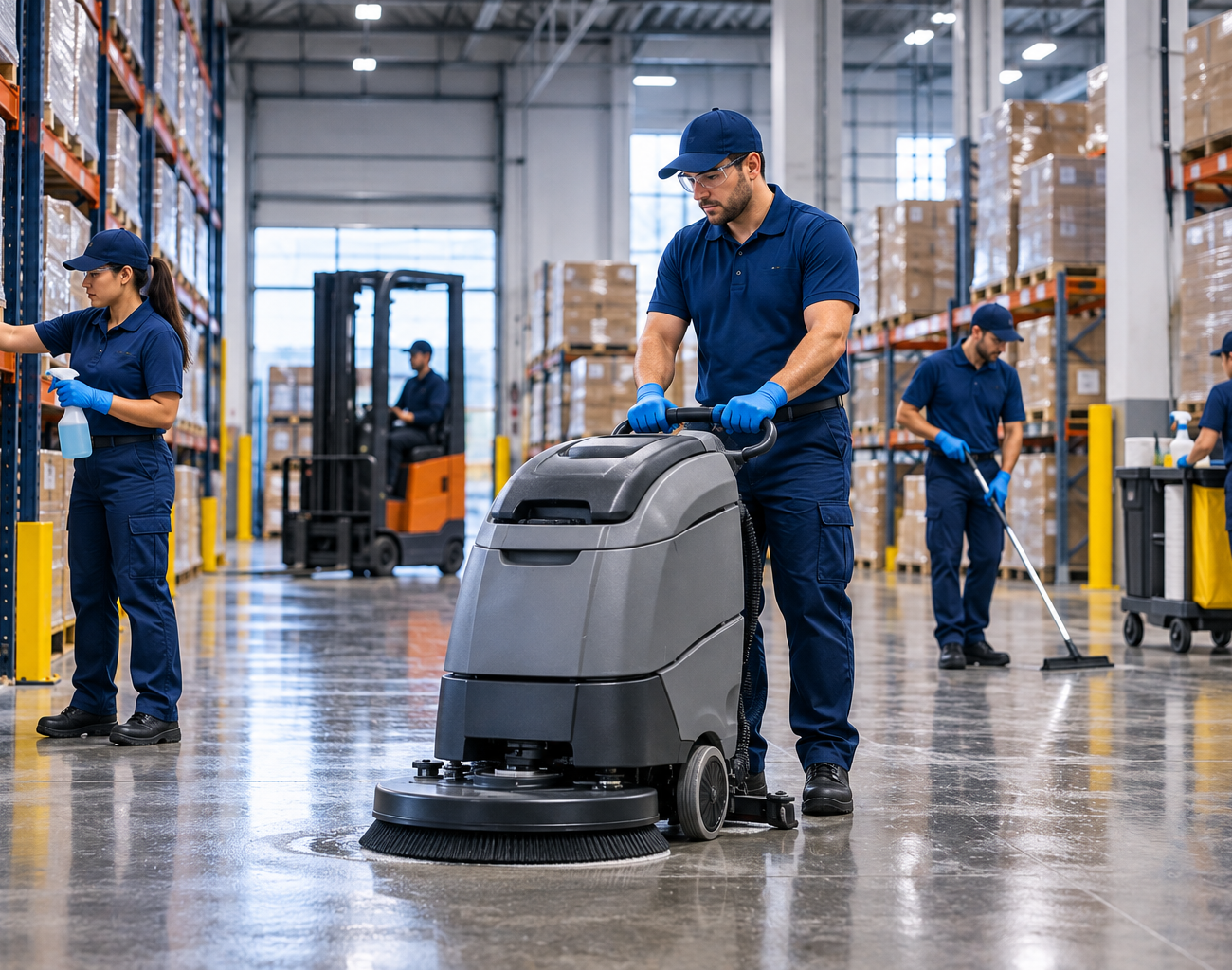
Most warehouse floors are sealed concrete, painted concrete, or an epoxy that someone put down in a shipping lane and then forklifted to death. A ride-on sweeper goes first. Dust left under a scrubber turns into a grey paste you’ll own. Then an auto-scrubber with the pad the finish can take. A black pad on a thin paint job lifts the coating. I’ve done that once, and the FM still has the photo.
- Expansion joints and saw cuts: sweep or vacuum them. A disk skips them and leaves pellets of grit.
- Battery charging rooms: neutralize what you can see, then mop. Don’t leave a wet trail into the aisle if there’s a live truck path.
- Painted walkways: scrub the lane, not the stripe, if the stripe is already peeling. We won’t “restore” a stripe that is failing.
- Entry mats: lift them, clean under them, and put them back dry enough that the next shift doesn’t skate.
Square footage is not a schedule
Square footage from a listing tells you little. A 40,000-square-foot 3PL with blocked aisles is a different night than an empty cross-dock. Walk it. Count the aisles you can actually open. That number is your crew size.
Food-grade rooms and industrial bays
These aren’t the same job. Industrial bays take dust, oil mist and tire marks. Food-grade rooms take a chemical list you’ve already approved, documented contact time, and a crew that doesn’t walk from a battery room into a high-care floor in the same pair of boots. Tell us which you run when you book. We quote from a walkthrough.
How often a high-care room needs a full rack wipe versus an aisle sweep isn’t something I’ll answer from a phone call. I’ve seen rooms that looked fine at 90 days and rooms that failed a swab at 30. Your QA person has the spec. We work that spec, or we write down that you don’t have one yet.
- Chemicals: they stay on the list you signed. We don’t “just use what we have on the van.” Ask any vendor for the safety data sheets for what they’ll bring on site.
- Drains and trench gutters: if they’re on the ticket. A pretty floor with a sour drain fails the next audit.
- Overhead pipes and cable tray: only if you asked and we can reach them without standing on product.
Rooms that get left off the ticket
Front offices, the lunch room and the washrooms next to shipping still get used on a night we only priced the slab. If you want them, say so. If you don’t, we leave the coffee cups and write it down. The same goes for the yard office and the driver’s washroom, which people remember when a customer walks through.
Spill kits, eye-wash stations and fire extinguisher cabinets get a wipe on the face. We don’t restock unless you put stock on the PO. If we can’t open a cabinet, we photograph it.
What to send before we price a night
- The floor plate
- Which doors stay live
- Whether food-grade rooms are in scope
- Photos of the worst aisle and one dock pit, which help more than a total square-foot number
We’ll tell you what a first night can cover and what has to wait until you empty a row.
Frequently asked questions
What does warehouse cleaning include?
After the last truck: aisle sweeping, racking and beam faces you’ve released, dock pits, plates, seals and bumpers, and floor scrubbing. Offices, lunch rooms and washrooms are added only if you put them on the ticket.
Do you clean racking?
We clean racking we can reach from the floor, or from a scissor lift if it’s on the ticket. We don’t climb racking or move product you haven’t signed off.
Can you clean while the warehouse is still running?
We work the aisles you release. If a pick module or a door is live, we skip it and come back.
Do you clean food-grade rooms?
Yes, from a walkthrough, using the chemicals and specs you’ve approved. Tell us at booking if you run food-grade rooms.
Book the walkthrough
We’ll walk the building or the drawings and tell you what a first night can cover before we lock a date. Book a free consultation.